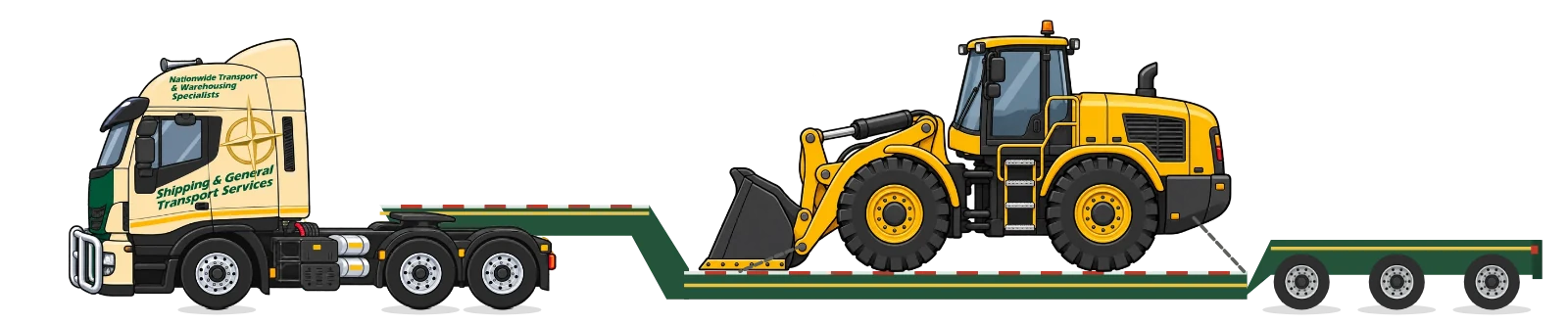
Abnormal load to move? Start with the brief.
Describe the load, the route and both sites. The brief builder lays it out the way the permit application asks for it, and shows what’s still missing.
- PermitsEvery province
- Risk analysisBefore the move
- Crane trucksOur own
Twelve answers, then the permits.
- 01
The load
What it is, with the make and model if it’s a machine. Its length, width, height and mass, from the drawings if you have them.
- 02
The sketch
Where the centre of gravity sits and how high it stands on the lowbed. Parts that can come off do: permits are for loads that can’t be split.
- 03
The route
From and to, the provinces in between and roughly how far. And the date it’s ready to move.
- 04
The sites
How it loads and offloads, and the gates, turns and overhead lines at each end. Then the risk analysis, the permits and the method statement.
Request an abnormal load quote
Your load
Step 1 of 7- Load
- —
- Width
- —
- Mass
- —
- From
- —
- To
- —
- When
- —
- Move brief
- Optional
Size, mass, route and a sketch
Every abnormal move starts with an exemption permit from each province on the route, and every application asks for the same things. With them in one brief, the permits, the risk analysis and the method statement can start straight away.
The load
- The descriptionMake and model for machines
- Size in mmLength, width, height
- Mass in kgAnd per axle unit
- Parts removed?Indivisible loads only
- Centre of gravityOn the sketch
The move
- ProvincesWith the km in each
- Route and datesFrom, to, how many days
- The rigIts registration numbers
- ProjectionsFront and rear overhang
- Route clearanceOver 125 t laden
Indivisible loads only
A permit is considered only for a load that can’t be split without disproportionate effort, cost or risk, and can’t be moved legally. The form asks what was taken off, and if nothing was, why.
Tall loads and power lines
Over 5.5 m laden, Telkom needs safe passage under its lines, and over 5.8 m Eskom too. Where a route can’t be cleared, they may escort the load.
Heavy combinations
Over 125,000 kg laden, a registered engineer’s route clearance goes with the application, and bridges on the route may need proof they can carry the load.
Where we operate
Our head office and 24-hour control centre are at 69–71 Barlow Road, Jupiter, Germiston, with an office in Durban. Our crews are trained in rigging, safety, risk management and first aid, our own crane trucks load on site, and the control centre tracks every move.
- Germiston depot69–71 Barlow Road, Jupiter, Germiston 011 873 4786
- Durban · Greyville81 Berea Road, Greyville, Durban 031 305 0438

Part of Shipping & General Transport
Shipping & General Transport is a privately owned South African logistics company built on trustworthiness, perseverance and reliability. Abnormal Trucks is one of its specialist services: abnormal loads on our own lowbeds and step decks, with the brief, the permits and the method statement, by one company.
Visit shippingandgeneral.co.zaWhat do you need from me to quote an abnormal load?
What the load is (with the make and model for a machine), its length, width, height and mass, its centre of gravity, whether any parts come off, drawings if you have them, where it goes from and to, when it’s ready, and how it’s loaded and offloaded at each end. The brief builder above collects it all in one place.
What does a permit application ask for?
The provinces on the trip with the distance in each; the load’s description, size in millimetres and mass in kilograms, and whether any part was removed; the vehicle combination with its dimensions, projections, laden height and axle masses; a sketch with the load’s centre of gravity; and the route and dates.
Why does the centre of gravity matter?
It goes on the permit sketch, and it decides where the load sits on the deck, which sets how its mass spreads over the axles. If it isn’t marked on your drawing, the maker usually knows it.
What counts as an indivisible load?
One that can’t be split into smaller loads without disproportionate effort, cost or risk of damage. Permits are only considered for loads like that, so parts that come off easily travel separately.
My load is taller than 5.5 m laden. What then?
Telkom requires safe passage under its lines over 5.5 m, and Eskom over 5.8 m. Where a route can’t be cleared, they may escort the load. Give us the height early, so the route can be planned around it.
When is an engineer’s route clearance needed?
For combinations over 125,000 kg laden, a registered professional engineer’s route clearance goes with the application. Larger loads may also be asked for stability calculations, and the carrier may have to prove that bridges on the route can carry the load.
The load is in a container or on a flat rack. Anything extra?
Yes: the application needs the container’s number, and a shipping bill describing the contents and their mass.
Who applies for the permits?
We do, through every province on the route, after a risk analysis. We arrange escorts and police where they’re needed, and write it all into a transport strategy and method statement.
How long do permits take?
The national guidelines set no processing time, and each province works to its own load. Send the brief as early as you can. Our sister site plans the days on the road once the permits are in.
Is my load abnormal at all?
On a normal truck and trailer the legal limits are 2.6 m wide, 4.3 m high and 18.5 m long, with mass limits per axle. Our sister site checks your load against them.
Lowbed or step deck?
The load’s height decides: a lowbed’s well sits lower, so taller loads stay under 4.3 m on it. Our sister site shows which trailer suits it.
What does it cost?
We don’t publish prices: answer the short questions in the quote form, add the brief if you like, and we’ll quote on your actual move.
What are we moving?
Seven short questions, plus the brief builder if you like. No prices online, just a quote on your actual load.